
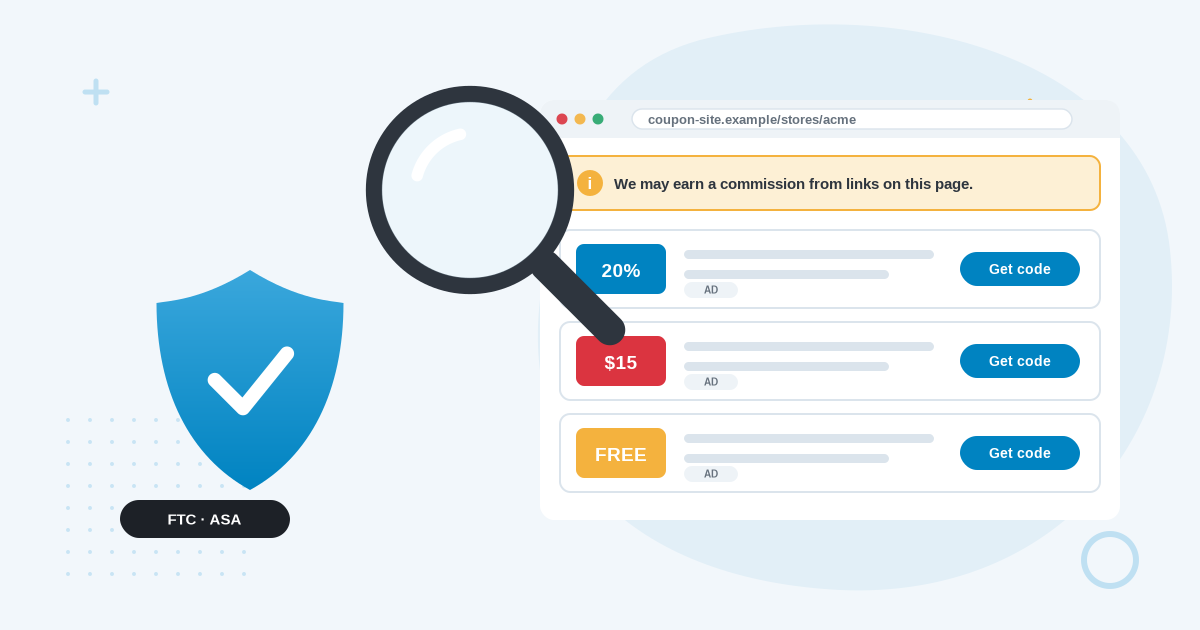
Say a coupon site in Leeds lists a discount on a £60 desk lamp. A shopper taps “Get code” on their phone, opens the retailer’s website and never reaches your footer. Your affiliate disclosure exists. They haven’t seen it.
That’s the problem worth solving: shoppers should understand your financial interest while deciding whether to act on an offer. A policy page helps explain your business, but it can’t repair a missed notice at the button. For coupon sites, disclosure belongs in the offer journey, including pages, code-reveal controls and emails.
couponPHP’s coupon and deal website script is a self-hosted PHP content management system for managing stores, offers and newsletters. That makes shared templates a sensible place to handle disclosure: an imported coupon needs the same visible explanation as a manually published deal. Software doesn’t decide whether your wording or placement meets the rules; your implementation does.
What the FTC expects from an affiliate disclosure
A shopper may read “our best desk-lamp deal” as your independent recommendation. If you earn money from the resulting purchase, that payment arrangement can affect how they judge it. Calling your site a coupon directory doesn’t tell them who pays you.
The FTC’s Endorsement Guides, 16 CFR Part 255, updated in 2023, explain how Section 5 of the FTC Act applies to endorsements. They are administrative interpretations, not a standalone rule that automatically imposes a fixed fine for every missing notice. Section 255.5 addresses unexpected material connections that could affect an endorsement’s credibility. An affiliate commission is the relevant connection in a typical coupon promotion. [1]
Your affiliate disclosure should explain that connection in ordinary language. You don’t need to publish your negotiated commission rate, but “partner link” leaves the financial relationship unclear. “We earn a commission on qualifying purchases through this link” tells shoppers what matters.
The 2023 Guides define clear and conspicuous disclosure as difficult to miss and easily understandable. Online, it should be unavoidable. Size, contrast and placement affect whether readers notice it; contradictory claims elsewhere can weaken the message. [1]
Payment isn’t the only connection. A free product used in a recommendation or payment for a featured position can also matter. Your explanation should match the benefit you’ve received, rather than treating every arrangement as a sales commission. That prevents a true but incomplete sentence from hiding the actual incentive.
UK rules: make the paid offer recognisable as advertising
A UK visitor might understand “we work with retailers” without recognising a particular deal as an advertisement. Say your page mixes a community-submitted lamp discount with a paid kitchenware promotion. One vague statement above the list doesn’t distinguish them.
The Committee of Advertising Practice writes the CAP Code, and the Advertising Standards Authority administers it. These are UK advertising self-regulatory requirements, distinct from the FTC’s US framework. CAP Code rule 2.1 requires marketing communications to be obviously identifiable; rule 2.3 requires clear commercial intent where context doesn’t already provide it. [4]
CAP’s Online Affiliate Marketing guidance, published in 2023, specifically covers voucher sites. Where context doesn’t make advertising obvious, paid offers should be identified. If only some offers contain affiliate links, shoppers should be able to distinguish those offers and links from the others. “Ad” near the relevant offer title is a suggested approach. [3]
For an all-affiliate page, a prominent explanation of its commercial nature may address the page as a whole. But an About page or terms link alone isn’t enough. CAP also advises upfront identification for wholly affiliate promotional articles, including their teaser links when the commercial nature isn’t otherwise clear. [3]
For a site serving both markets, an Ad label plus a plain commission sentence is a useful starting point. The label identifies advertising; the sentence explains your incentive. This isn’t a guarantee for every layout, but it addresses both questions without requiring shoppers to understand affiliate terminology.
Near the link or in the footer?
A desktop store page can look clear while its mobile version hides the notice below a carousel. Or a shopper arrives at an offer halfway down the page through an anchor link. They’ve bypassed your carefully written opening paragraph.
The FTC’s 2023 staff Q&A says proximity to the recommendation matters. A single disclosure may suffice when readers can see the disclosure, recommendation and link together. If they’re separated, readers may miss the connection. It also rejects a “Disclosure” or “Legal” button that merely links to an explanation: the information is too easy to avoid. [2]
For a short store page, your notice can sit immediately above the coupon list. On a long page, a brief notice within each paid offer card is usually a better design choice, because each card remains understandable when viewed alone. There’s a small space cost. It’s worth accepting rather than depending on readers remembering a distant banner.
“Get code” deserves special attention. If it opens a retailer tab while revealing the code, the commercial action begins with that tap. A disclosure inside the resulting popup comes too late for that decision. Visible text beside or immediately above the original control explains the relationship beforehand.
The same reasoning applies to sticky “Shop deal” buttons. When a control detaches from its card, its explanation shouldn’t disappear. A notice that travels with the sticky unit can keep the relationship visible.
A footer remains useful for fuller policy details. It isn’t the main notice. Your practical test is whether someone can encounter and use the paid offer without encountering its explanation.
Disclosure wording for coupon pages and buttons
A copied disclaimer can describe the wrong business model. For example, “we earn from purchases” misses a retailer that pays for newsletter placement regardless of sales. The wording should describe your actual coupon affiliate arrangements, not whatever another publisher uses.
The following examples are starting points, not prescribed legal formulas. Each belongs where shoppers encounter the relevant promotion.
A store page containing only affiliate offers
A visitor sees several coupon buttons but no indication that your site benefits from their purchases. An opening notice immediately above that short list could read:
Ad: These offers contain paid links. We earn a commission on qualifying purchases made through them.
This connects the explanation to the whole list. Longer lists may still need repeated notices where offers become separated from that opening text.
A paid card in a mixed offer list
A shopper shouldn’t have to guess which coupon is commercial. A paid offer card could show:
Ad — We earn a commission on qualifying purchases through this offer.
An unpaid offer doesn’t need the same label merely because it shares the page. Accurate identification avoids implying that every community contribution has a commercial connection.
A code-reveal or shop button
A button labelled “Get code” explains the action, not your payment. Nearby text could say:
Paid link: We earn a commission on qualifying purchases.
The FTC Q&A says “paid link” immediately next to an affiliate link should adequately disclose its nature. [2] The longer sentence adds context for shoppers unfamiliar with performance-based advertising. For UK-facing cards, an Ad label should also identify the offer where its advertising nature isn’t otherwise apparent.
A retailer paying for a featured position
A commission-only notice won’t explain a paid ranking. Beside the promoted card, a more accurate version is:
Ad: This retailer paid for this featured placement. We also earn a commission on qualifying purchases through the link.
The second sentence belongs there only if it’s true. “At no extra cost to you” is optional, and you shouldn’t include it unless you can substantiate it for the arrangement. Payment disclosure doesn’t require a promise about prices.
Emails need their own visible explanation
Say your daily newsletter starts with a lamp offer and a “Shop now” link. The commission notice sits underneath the unsubscribe block. A reader who acts on the first offer won’t reach it, and a disclosure on your website doesn’t explain the email they’ve already read.
A short paid-offer email could place this before its first promotion:
Ad: We earn a commission on qualifying purchases through the offers in this email.
When only certain offers are paid, the individual sections should identify them instead. For a long message, local notices help if readers skip directly to a later promotion. The FTC’s proximity principle still matters, and CAP’s affiliate guidance expressly includes emails. [2] [3]
“Do I need this if the email links to my own site?” The destination alone doesn’t settle it. A promotional email can form part of the commercial message even without a direct retailer link. Its content and context matter.
For unsolicited UK marketing emails, CAP rule 2.2 also requires identification as marketing without opening the message. [4] That’s separate from the commission explanation inside it. Your email list-building process also needs its own consent and unsubscribe checks; an advertising label doesn’t answer those questions.
Common mistakes that leave shoppers guessing
A publisher can have accurate policy wording and still produce an unclear page. Imagine a pale “affiliate” label, a commission sentence behind an information icon and a bright button visible before both. The strongest visual cue is the action; the explanation barely competes.
Several errors deserve specific fixes:
- Using jargon alone. The FTC Q&A says “affiliate link” may not explain that purchases generate payment. A commission sentence or adjacent “paid link” wording gives readers usable information. [2]
- Putting the explanation after the click. A popup notice doesn’t help someone understand the original button. Keeping the text at the first action point addresses that decision.
- Saying only “we may earn.” CAP guidance warns against ambiguous generic wording, particularly when paid content isn’t identified. “We earn on qualifying purchases” states the relationship while describing its condition. [3]
- Relying on an HTML attribute. Your rel=“sponsored” link setup concerns machine-readable link information. It doesn’t provide a visible explanation to shoppers, so it can’t replace one.
- Claiming disclosure makes a deal reliable. An Ad label says nothing about whether a code works. A claim such as “verified today” still needs evidence; a payment notice can’t validate it.
These fixes don’t require a wall of legal text. They require the right information at the right decision. A conspicuous sentence is more useful than a long policy that the shopper never opens.
Imported offers need disclosure-aware templates
An editor can label yesterday’s paid deal correctly while tonight’s feed adds unlabelled cards. Say an automated import replaces a retailer’s destination URL and the offer becomes monetised. Your manual page checks won’t necessarily catch that change.
A practical implementation keeps offer-level commercial information separate from the descriptive copy. Your data model can record affiliate status, paid placement and the applicable notice. Shared templates can then display the right explanation on store pages, search results and newsletter blocks. This is an implementation recommendation, not a claim that any particular script already provides those fields.
Your coupon API workflow should account for missing or changed relationship data. An absent flag shouldn’t silently become a confident “unpaid” claim. Reviewing uncertain records before publication prevents the template from displaying misleading labels.
After a template or import change, checks should include direct entry into a card, mobile wrapping, code-reveal behaviour and the newsletter version. You’re checking the rendered journey, not just whether a disclosure string exists in the database.
Frequently asked questions
The awkward cases tend to arise in ordinary layouts: a footer policy, a long list or a conditional commission sentence. These answers apply the same visibility and identification principles to those situations.
Is a footer disclosure enough for a coupon website?
Usually, no. A shopper can click the first offer without reaching the bottom. Your affiliate disclosure should explain the relationship where the shopper encounters the recommendation or link. A footer can hold a fuller policy, including how paid placements work, but it shouldn’t be the only place visitors learn that purchases generate commission. [2] [3]
Do I need a disclosure next to every affiliate link?
A compact card showing its recommendation, notice and link together may need just one notice. The FTC doesn’t prescribe a separate sentence for every link regardless of context. But a long list or detached sticky button can separate the action from the explanation. Local notices address that separation; UK mixed-offer pages also need recognisable paid offers where context is unclear. [2] [3]
Can I write that I may earn a commission?
If a sale qualifies for payment, conditional wording can describe that condition. It shouldn’t obscure which offers are advertising. CAP warns against ambiguous generic “may receive” statements. “Ad: We earn a commission on qualifying purchases through this offer” is a clearer option because shoppers see an established financial relationship rather than a speculative possibility. [3]
The release test belongs at the first paid click
Say your redesigned page passes a desktop review, but its sticky mobile button loses the notice. It isn’t ready. A useful release check starts with a direct visit to that offer on a phone: can you understand that it’s advertising and how your site earns before you tap? If the answer depends on finding the footer, your next change belongs beside the button.


