A shopper finds a saucepan on sale, copies your discount code and expects cashback too. At checkout, the code replaces another offer. The advertised bargain disappears, and your coupon site gets the blame.
Coupon stacking means combining eligible discounts or rewards on the same purchase. That can include a manufacturer coupon with a store coupon, a promo code on sale stock, or cashback alongside a loyalty benefit. The word eligible matters. Each layer has conditions, and savings at checkout differ from rewards paid later. Your job is to explain the combination a shopper can reproduce, rather than advertise the largest theoretical saving.
What counts as coupon stacking?
A shopper clips a coupon inside a retailer’s app and calls it a store coupon. But the product manufacturer may have issued it. Pairing it with a paper manufacturer coupon could breach the terms, even though the formats look different.
This distinction matters for publishers using couponPHP, a self-hosted PHP coupon and deal website script. Its coupon website management features let you organize stores, coupons and deals; your editorial checks establish whether those offers actually combine.
Wikipedia’s coupon overview distinguishes retailer-issued coupons from manufacturer-issued coupons.[1] The issuer and the delivery format are separate facts. Paper, digital and printable offers aren’t automatically different discount categories.
A useful offer record identifies the layer involved:
| Layer | Example | What you need to establish |
|---|---|---|
| Manufacturer coupon | $5 off a specified saucepan | Eligible model, quantity and reimbursement terms |
| Store coupon or promo code | 10% off eligible cookware | Whether it combines with the manufacturer coupon |
| Sale price | Saucepan reduced to $80 | Whether coupons apply to reduced stock |
| Cashback or rebate | 5% returned after purchase | Eligible code, spending base and approval conditions |
| Loyalty benefit | Points earned or redeemed | Whether earning and redemption work with the other layers |
A sale plus one code can be a valid combination without multiple code fields. Stacking also differs from doubling: doubling increases one coupon’s value under a promotion’s rules. Recording the discount category prevents you from confusing those mechanics.
Why the same offers produce different checkout totals
Say a hypothetical Chicago kitchenware shop accepts a store code online but excludes clearance products. Its physical shop accepts a manufacturer coupon on those products. A store-wide “stackable” label won’t tell readers which route works.
Your rules need to describe the combination, not the retailer in general. For each offer, record the sales channel, country, eligible products, account requirements and expiry time zone. Also record whether restrictions apply per item, transaction or household. “One coupon per purchase” needs clarification; you can’t safely translate ambiguous wording into a checkout instruction.
Three details deserve special attention:
- Application order: a fixed-dollar reduction followed by a percentage reduction can produce a different total from the reverse sequence.
- Threshold calculation: a $75 minimum could refer to the basket before or after discounts. Tax, shipping and excluded products may not count.
- Combination limits: a shipping code might coexist with a product code while two order-wide percentage codes cannot.
The practical response is a permitted-combinations record with four statuses: confirmed compatible, prohibited, conditional and unknown. That gives your editors a usable publishing decision. An empty rule field isn’t permission.
Imported offers need the same checks. The coupon API guide explains importing offer data, but a feed containing two valid codes doesn’t establish that they work together.
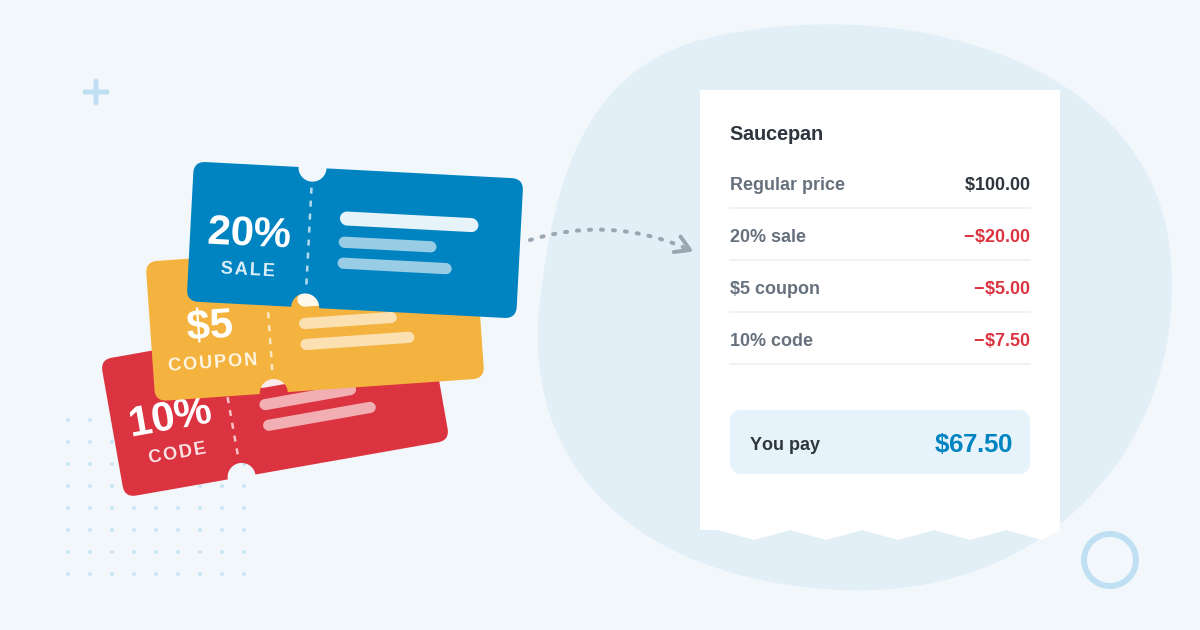
Coupon stacking example: $100 becomes $67.50 at checkout
A coupon card says “20% sale plus 10% code: save 30%.” That arithmetic fails when the second discount applies to the reduced price. On $100, those percentage discounts alone produce $72: $100 × 0.80 × 0.90. The reduction is 28%, not 30%.
Here’s a fuller hypothetical example. Say an Austin cookware retailer expressly permits the following sequence on a saucepan with a genuine regular price of $100. Tax and shipping are excluded, and the shopper meets every eligibility condition.
| Step | Calculation | Merchandise amount |
|---|---|---|
| Sale takes 20% off | $100 × 0.80 | $80.00 |
| Manufacturer coupon takes $5 off | $80 − $5 | $75.00 |
| Store code takes 10% off the remainder | $75 × 0.90 | $67.50 |
| Conditional cashback pays 5% of $67.50 | $67.50 × 0.05 = $3.375 | $3.38 cashback |
| Cost after cashback is received | $67.50 − $3.38 | $64.12 |
The cashback program in this example rounds half a cent up. Its actual rounding method and eligible spending base would need checking before publication.
The shopper pays $67.50 for the merchandise now, a $32.50 reduction, or 32.50%. If the $3.38 cashback arrives, the reduction becomes $35.88, or 35.88%. Those are different claims.
Order matters here. Applying the store code before the manufacturer coupon gives $80 × 0.90 − $5 = $67.00, rather than $67.50. Your example should follow the merchant’s actual calculation order, even if another sequence looks cheaper.
How your offer card should separate price from rewards
“Get this saucepan for $64.12” sounds like the checkout price. It isn’t. A reader who must pay $67.50 before tax and shipping has a reasonable complaint if the cashback requirement appears only after clicking.
The FTC’s Advertising FAQ’s (April 2001) says rebate advertisements should prominently state the before-rebate cost and rebate amount. It also calls for disclosure of relevant purchase conditions, fees and expected receipt timing.[2] The same separation is a sensible editorial standard for your reward-dependent price claims.
A useful card for the hypothetical saucepan would read:
Pay $67.50 before tax and shipping. Combine the sale price, eligible $5 manufacturer coupon and 10% store code in that order. Potential $3.38 cashback brings the merchandise cost to $64.12 after payment. Cashback approval and eligibility conditions apply.
The expanded instructions should give the exact product model, quantity, account status, code and test date. You’ll also need the reward claim deadline and expected payment timing from the relevant terms. If those details aren’t available, the reward belongs in an unverified note rather than the headline saving.
An affiliate disclosure belongs near the earning link, following your affiliate disclosure policy. A disclosure explains your commission; it doesn’t make an inaccurate price claim acceptable.
How to test a stack before calling it verified
Your editor tests each code alone and both pass. A visitor applies them together, and the second removes the first. Testing individual offers hasn’t tested the stack.
A repeatable test starts with a baseline basket: the same product, quantity, region and shopper eligibility you’ll describe. You can then test each layer individually before testing the full permitted sequence. This shows which step changes the result and makes failures easier to diagnose.
Your test record should include:
- The current coupon terms and retailer policy, with their capture dates.
- The baseline basket and each discount line after the full sequence is applied.
- Account status, channel, shipping method, timestamp and expiry time zone.
- Screenshots of the total, exclusions and any warning that another offer was removed.
- A separate cashback status: terms checked, tracked, approved or paid.
A checkout test verifies the displayed calculation, not future cashback approval. Where you have authorization to make a test purchase, a later paid reward supplies stronger evidence. You shouldn’t place orders merely to decorate a verification badge.
Cashback also needs a defined click path. Last-click attribution means the last eligible referral can receive credit under a program’s rules. Your coupon link and a cashback link may compete for that credit; the last-click attribution guide explains why the sequence matters. Testing should follow the route you actually recommend.
Failures are useful evidence. You can check an excluded product and a basket just below the threshold, letting a boundary test reveal what a successful basket hides.
A specific label works better than a broad badge: “Checkout combination checked September 30; cashback terms checked, payment unconfirmed.” Rechecking after a terms change or a reported failure keeps that claim tied to evidence. You don’t need to pretend yesterday’s result guarantees tomorrow’s checkout.
Merchant margin risk starts with who funds each layer
A merchant sees a $67.50 sale and compares it with a $45 product cost. That leaves $22.50 before other costs. Fulfillment and affiliate fees can change the decision, while a valid manufacturer reimbursement can move it the other way.
Using our hypothetical saucepan, assume the manufacturer reimburses the retailer $5. Let product cost be $45, fulfillment $8, affiliate payout $4 and payment processing $2. These are illustrative costs, not industry averages.
Contribution before overhead, returns and future reward liabilities is:
$67.50 + $5 − $45 − $8 − $4 − $2 = $13.50.
Now suppose an unintended extra 25% code applies to $67.50. With half-up rounding to cents, the customer pays $50.63. Contribution becomes $50.63 + $5 − $59 = −$3.37. An apparently successful order loses money before overhead.
The merchant needs a funding record and a minimum contribution check for every permitted combination. Cashback isn’t automatically another merchant expense: if it’s funded from an affiliate payout already counted, subtracting it again would double-count the cost. Uncertain manufacturer reimbursements also shouldn’t be treated as guaranteed cash.
A discount ceiling helps, but product exclusions and contribution checks offer better protection where costs vary. Your coupon marketing strategy should connect those controls to the promotion’s objective. Checkout acceptance alone doesn’t establish commercial approval.
Price comparisons need their own evidence. The FTC’s former-price guidance, published in 1967 and codified at 16 CFR 233.1, requires a genuine former price rather than an inflated reference price.[3] Correct discount arithmetic can’t rescue a fictitious starting price.
Frequently asked questions
Readers may have two valid offers without a valid combination. A paper coupon and an app coupon are a common example. Your answers should identify the missing rule before promising savings.
Can you use two manufacturer coupons on one item?
Two delivery formats can disguise the same restriction. A paper manufacturer coupon and one clipped in a retailer’s app may both apply to the same item, with terms that prohibit combining them. You shouldn’t assume they’re compatible. A safe publishing rule is to require express permission in the coupons’ terms and the retailer’s policy. If permission isn’t clear, the combination remains unverified rather than recommended.
Can a promo code cancel cashback?
A shopper can see a code accepted and still lose the expected reward later. Cashback terms may exclude that code or require a particular referral route. Checking permitted codes, the eligible spending base and tracking conditions before publication helps prevent this mismatch. Your price card should keep cashback separate until it’s paid. Coupon stacking can work at checkout while the reward portion remains unconfirmed.
Do loyalty points count as cash savings?
A shopper redeems $5 of existing points against the $67.50 merchandise amount and pays $62.50. That’s lower cash outlay, but the shopper has also spent an asset they already held. Newly earned points are a future benefit, with their own redemption conditions. Showing cash due, points spent and points earned separately prevents you from counting one reward as new savings both when it’s earned and when it’s redeemed.
Publish the payable price before the reward
A visitor who can reproduce $67.50 at checkout learns more from your offer than one who sees an unexplained $64.12 headline. The smaller-looking promise is the more useful one.
Your next stackable offer can include the permitted sequence, checkout amount and dated test result, with conditional rewards shown separately. If you can’t document a layer, leaving it out of the advertised saving protects the reader from financing your uncertainty.