You upload a PHP application and receive an encoded-file error before the installer opens. The database password may be perfectly correct. When a package needs ionCube Loader, PHP must load that extension before it can execute the encoded files. Changing folder permissions won’t solve a missing runtime extension.
couponPHP is a self-hosted PHP coupon and deal website script, and some of its files are encoded. Its server requirements also include a database and other PHP extensions. Check that complete set before uploading production files; the Loader addresses one installation dependency, not every one.
ionCube Loader: match the runtime before installing
A hosting account can have several PHP versions. You might select one for the website while php in the terminal points to another. A working homepage and a failing cron import can therefore be two different runtime configurations, not contradictory evidence.
Wikipedia’s ionCube article, consulted in 2026, describes the Loader as the PHP extension that reads and executes encoded files at runtime.[1] Encoded software introduces two checks: the extension must load into your PHP build, and that build must be compatible with the application’s encoded package. Don’t assume that “latest” satisfies both.
On Linux with terminal access, collect the basic details:
php -v
php --ini
php -i | grep -E 'Thread Safety|Architecture|extension_dir'
uname -m
The PHP Group’s command-line documentation, consulted in 2026, defines these diagnostics.[2] They describe CLI PHP; check the website’s runtime separately through your panel or a restricted diagnostic page.
Match operating system, processor architecture, PHP major/minor version and thread-safety mode. On Windows, compiler and build settings also matter. The PHP Group’s extension-installation documentation, consulted in 2026, explains why compiled extensions must match the executable’s settings.[3] “64-bit server” isn’t enough if PHP itself is a different build.
Choose host-managed setup when you lack server access
On shared hosting, you might have no permission to edit startup configuration or restart PHP. Copying a Loader file into public_html won’t make PHP load it. Extension installation happens outside normal application code execution.
Use the account’s PHP extension selector if it offers the correct Loader. Otherwise ask the host to enable a compatible build for both the website and its CLI jobs. Give support the PHP version, operating system and exact encoded-file error so they can distinguish a missing extension from a package compatibility problem.
On your own server, obtain a matching binary through a trusted channel. Keep it outside the document root, back up the configuration and test in staging.
The release history and script support channel can clarify supported runtimes. If only obsolete PHP works, resolve the application build rather than keeping that runtime exposed.
Add zend_extension to the active configuration
A common failure is editing a php.ini that the relevant process never reads. php --ini reports the CLI configuration file and scanned directories. The website’s loaded configuration path may be different, so record both.
The PHP Group’s core configuration manual, consulted in 2026, documents zend_extension as a startup configuration directive for Zend extensions.[4] The following is an illustrative Linux PHP 8.3 entry, only where your matching package actually supplies this filename:
; Example only: use the matching supplied binary and its real path.
zend_extension = "/opt/ioncube/ioncube_loader_lin_8.3.so"
Use your matching file and real path, following its loading-order requirements. Don’t duplicate a host-managed entry in another ini file.
Your host can apply the service reload. On your own server, reload the relevant PHP-FPM or Apache service; names vary. New CLI invocations read configuration afresh, but existing web workers need the change applied.
Verify the website and cron separately
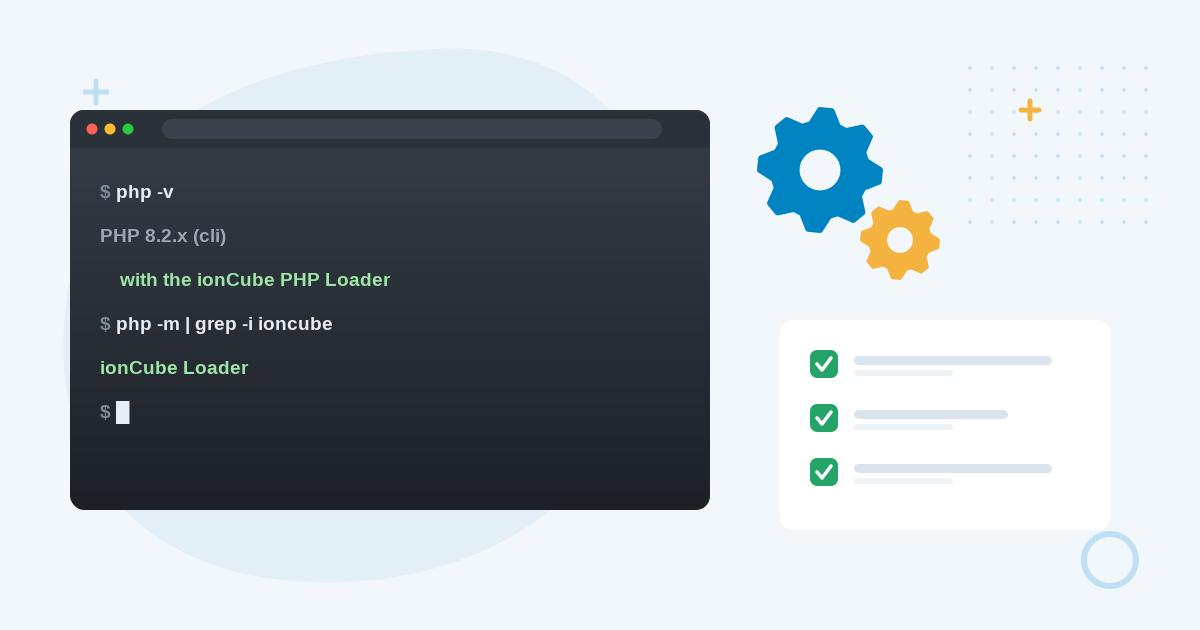
“No startup warning” isn’t enough. Confirm the extension appears among loaded modules and then execute the actual encoded application. In the terminal:
php -v
php -m
php -r 'print_r(get_loaded_extensions(true));'
The last command lists loaded Zend extensions. If startup fails, read the error before attempting another installation. A wrong path, unreadable file or incompatible binary points to different repairs.
For the website, a temporary authenticated diagnostic using phpinfo() can show the loaded ini path and extension sections; PHP’s extension guide describes that verification method.[3] Remove it after checking. A public information page can expose paths and configuration that visitors don’t need.
Then run one background command using the same absolute PHP executable you’ll use in cron. If the website works but the command fails, compare the CLI configuration and extension selection. The cron setup guide explains the next step after installation.
Finish installation without leaving broad write access
The installer needs to save configuration and uploaded images need writable directories. But a blanket 777 change lets every local user write to the target on a normal Unix permission model. That can hide an ownership problem rather than solve it safely.
The PHP Group’s chmod manual, consulted in 2026, explains the owner, group and other permission bits.[5] A directory set to 755 is writable by its owner, not automatically by whichever user runs PHP. Ask the host to confirm ownership and the PHP execution user before changing permissions.
Use the narrowest permissions that let the required process write. Configuration files don’t need directory-style execute bits. Restore the configuration file’s restricted permissions after installation, confirm the site still reads it, and remove the installer directory. Create the database and user before starting so a runtime error isn’t confused with a database setup error.
The original 2016 installation guide
The recovered steps below date from 14 July 2016. Historical download and vendor-documentation links have been removed while their recommendations remain. Use HTTPS today. The 755/777 advice is retained as history; apply the ownership-based guidance above instead of broad permissions.
Installing CouponPHP has never been easier. Follow the steps below to complete your setup process!
- Unpack the downloaded package with your favorite archiving tool. For Windows we suggest WinRar and RarExpander for Mac. If you are on Linux you already know your favorite unrar tool.
- Upload the contents of the package to your server’s public_html (on some hosting accounts it is called httpdocs or htdocs) folder.
- Give write access for the following files / folders. couponPHP keeps some data in plain text files so it is important to make these folders writable. You can enable writing for a specific folder by chmod-ing it to 755 or 777. Look up your FTP software’s documentation for help. The folders to make writable:
- public_html/vars.php – This file will contain the configuration after the install process. When you are done with the installation you can set the permissions back as they were.
- public_html/thumbs – This is where couponPHP keeps the thumbnails for coupons / deals / stores and users.
- public_html/thumbs/stores
- public_html/thumbs/coupons
- public_html/thumbs/users
- public_html/cache – couponPHP will cache here to boost your site’s performance.
- Navigate your browser to http://yourdomain.com to invoke the installation process.
- Follow the instructions from the installer. It will ask you for your database details so make sure you set up one beforehand. The original guide referred readers to cPanel’s MySQL Databases documentation for creating a database and user. Make sure your database user has the right permissions for the database.
- When the installer finishes remove the install folder from your public_html.
- You are done. Enjoy your new site. You can access your admin area at http://yourdomain.com/admin.
- It is time to set up your cronjobs, using the guide linked above.
Frequently asked questions
Why is ionCube Loader installed but my website still reports it missing?
You may have enabled it for a different PHP version or runtime. Terminal PHP and the website’s PHP-FPM or Apache runtime can load separate configuration files. Check the website’s active PHP version and loaded php.ini, enable the matching extension there, and reload the relevant service before testing again.
Can I install ionCube Loader on shared hosting?
Often the host must provide or enable the server extension. Check its PHP extension selector and ask which PHP builds have the Loader available. Uploading a binary into your website directory doesn’t make it active. Confirm compatibility with your exact encoded application package before changing the account’s PHP version.
Will a newer Loader make every old PHP package work?
No. A Loader must match the PHP runtime, and the encoded package must also be supported on that runtime. A newer extension doesn’t remove every compatibility constraint in old code. If your package requires unsupported PHP, ask for a supported build and test it in staging before updating production.
Keep the runtime details with your installation notes
Record the web PHP version, CLI executable, Loader configuration and writable directories once setup works. When a host changes PHP later, those details let you compare the working installation with the new one before running live imports.