

A £50,000 asking price can look persuasive beside an earnings screenshot. But a screenshot doesn’t tell you whether commissions were paid, advertising costs were deducted, or the buyer can keep the affiliate relationships. When comparing affiliate websites for sale, your first question should be: what income and assets will actually survive the handover?
Say a Leeds coupon site reports £2,400 a month. That could be revenue before expenses, rather than money available to its owner. The difference changes your offer before you even discuss search rankings.
couponPHP is a self-hosted PHP coupon and deal website script with outgoing-click reporting and an integrated analytics dashboard. Those records can support a buyer’s investigation, but software reports alone don’t verify earnings or confer ownership of accounts.
Affiliate websites for sale: value recurring net profit
Listings of affiliate websites for sale may advertise a multiple without defining the profit beneath it. Your comparison needs the same period, currency, and cost treatment for every listing. Otherwise, a cheap-looking business can become expensive once you pay someone to maintain it.
The U.S. Small Business Administration’s acquisition guidance, accessed in 2026, describes several valuation approaches and recommends reviewing financial statements, tax returns, and contracts. It does not supply a standard coupon-site multiple. [1]
Here’s a hypothetical example, not a market benchmark or a result from the archived website:
| Monthly item | Assumed amount |
|---|---|
| Approved affiliate earnings after reversals | £2,400 |
| Hosting | £120 |
| Offer feeds and tools | £180 |
| Editing and coupon checks | £300 |
| Paid promotion | £200 |
| Administration | £100 |
Expenses total £120 + £180 + £300 + £200 + £100 = £900. Monthly operating profit is £2,400 − £900 = £1,500, before tax and financing.
If buyer and seller hypothetically agree on 30 times monthly profit, the proposed price is £1,500 × 30 = £45,000. Thirty is an illustrative assumption, not a claim about current market prices.
Now suppose the owner also performs work that will cost you £300 a month to replace. Adjusted profit becomes £1,500 − £300 = £1,200. At the same assumed multiple, £1,200 × 30 = £36,000: a £9,000 difference.
You won’t necessarily pay the same multiple after this discovery. The example isolates the effect of missing labor costs. A simple price-to-profit payback calculation also ignores taxes, financing, changes in earnings, and your eventual resale value.
When comparing affiliate websites for sale, review a full year of monthly results alongside recent months. This exposes a Christmas spike or declining earnings hidden inside an annual average. Our affiliate marketing metrics guide explains how clicks and approved commissions connect.
What should your due diligence checklist cover?
A tidy spreadsheet can conceal unrelated traffic or income from another property. Evidence should connect the site, the visitor source, the merchant click, and the eventual payment. Ask for access that lets you examine records without changing production settings.
Traffic source verification. Request read-only analytics and search-performance access, then compare them with server logs and campaign records. Examine landing pages, countries, devices, and channel trends. Ask why a large referral source exists. Logs include bots, and analytics can miss consent-restricted visits, so discrepancies need explanation rather than automatic accusations.
Affiliate account transferability. Record each network, merchant, commission arrangement, and account holder. Seek written confirmation of what the proposed ownership change requires. You may need new publisher approvals or tracking identifiers. A seller’s password isn’t evidence that you can legally continue earning under their account. Use the coupon affiliate programs guide to organize these questions.
Earnings proofs. Reconcile network transaction exports with approved commissions, reversals, payment statements, and bank receipts. Keep sale dates separate from payout dates. Ask the seller to identify every included website, because one account may report several properties. An accountant can help reconcile timing differences without treating pending earnings as cash.
Algorithm-update history. Build a dated record of traffic changes alongside search updates, migrations, outages, content edits, and spending changes. Ask for recovery work and any recorded manual actions. Timing alone doesn’t prove that an update caused a decline. Compare affected pages and queries with unaffected ones; the affiliate SEO guide provides context for that review.
Content ownership. Inspect writer agreements, image licenses, source-code permissions, and feed contracts. The U.S. Copyright Office (2024) explains that commissioned work qualifies as work made for hire only under defined conditions. Paying a freelancer doesn’t automatically satisfy them. Obtain evidence of ownership or an appropriate transferable license; local law and the contract matter. [2]
The purchase agreement should name the assets and exclusions. A domain, database, newsletter list, merchant relationships, and software licenses are different items. Your lawyer should also review how subscriber data can lawfully change hands; a downloadable email file doesn’t resolve privacy obligations.
Red flags worth pausing the purchase for
Suppose visits double just before a listing goes live, but approved earnings stay flat. That calls for campaign invoices and source records, not a bigger offer. A traffic chart can demonstrate activity without demonstrating buyer intent.
Other warning signs include screenshots without underlying exports, excluded routine costs, unexplained tracking changes, and profit concentrated in a merchant whose approval hasn’t been confirmed. “No work required” deserves a task log: someone must handle expired codes and broken imports.
A seller who blocks reasonable verification creates a problem you can’t price accurately. A seller who explains a weak month and provides records gives you something you can evaluate. Lower profit isn’t automatically a deal-breaker; concealed uncertainty is harder to manage.
Before placing money at risk, agree on verification milestones, third-party approvals, and a documented transfer process. Transaction safeguards don’t replace due diligence.
What makes a coupon site sellable after the owner leaves?
An attractive design isn’t an operating manual. Say the seller personally checks codes every morning and knows which feeds produce expired offers. If that knowledge isn’t written down, your projected costs may be wrong from day one.
A useful handover package explains import schedules, offer checks, backups, credential changes, and merchant-link replacement. It includes a restore test and the actual license documents, rather than assumptions about transfer rights.
For sellers, a weekly task log makes hidden work visible. Show earnings by merchant and explain reliance on particular traffic sources. Test a sample of offers before listing the business; dead codes create maintenance work for the buyer. The coupon marketing strategy guide can help describe how the audience is served beyond a search visit.
The price discussion becomes more useful when another operator can trace a paid commission to its source and repeat the process without your personal accounts.
The original 2017 post
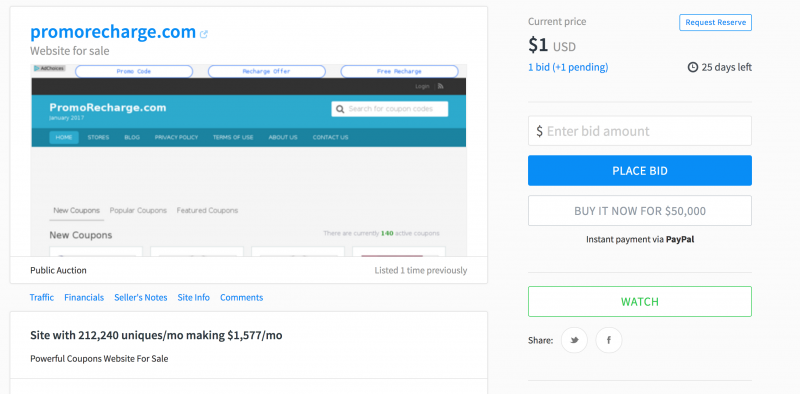
Editor’s note: this January 2017 showcase discussed an advertised asking price, not a verified completed sale. The recovered wording and image are retained. The historical commercial address is inactive text, not a recommendation.
We’d like to share with you one of the ideas of how to make fast and big make money using our script.
This is an advertisement we’ve stumbled upon on the internet about a coupon website generating stable income and being sold at a pretty large amount of money:
<https://flippa.com/7902113-promorecharge-com>
Hope it will inspire you to continue working on your own coupon website.
Frequently asked questions
How do you value an affiliate website?
Start with verified monthly earnings after reversals and realistic operating costs. Then assess how likely that profit is to continue under new ownership. A profit multiple can express a proposed price, but it is not a guarantee or universal benchmark. Compare the underlying risks, transition costs, and your own required return before agreeing a price.
Can affiliate accounts transfer with a website?
That depends on the current network and merchant agreements and the transaction structure. Buying a domain does not establish permission to use the seller’s affiliate accounts or commission terms. Obtain written confirmation about ownership changes, new applications, tracking identifiers, and outstanding commissions before closing. Make any necessary approvals a condition of the purchase.
What makes a coupon website sellable?
A buyer needs earnings they can verify, traffic they can explain, and assets they can legally operate. Document offer maintenance, content ownership, software licenses, affiliate approvals, and recurring expenses. Show the work required to keep coupons useful. A repeatable operating process reduces dependence on the seller, although it cannot guarantee future traffic or profit.
Did the coupon website in the original post sell for $50,000?
The recovered 2017 post highlighted an advertisement for a coupon website being offered for sale. It does not establish a completed transaction, the final price, or verified ongoing earnings. The original text and screenshot remain above as historical material. They should not be treated as a current listing or a valuation benchmark.


